



- Thermocouples
- Screw-in thermocouple
- Plug-in thermocouple
- Dipstick-Thermocouples
- Wire thermocouple
- Sheathing-tube thermocouples
- Sheathed thermocouple
- Surface thermocouple
- Screw-in resistance thermometer
- Plug-in resistance thermometer
- Wire resistance thermometer
- Sheating tube resistance thermometer
- Sheathing resistance thermometer
- Accessories Thermocouples
- Surface resistance thermometer
- Sheathed thermocouple with terminal head
- Thermo connectors
- More products
Speed Vs. Durability – The Trade Off In Wire Thermocouples
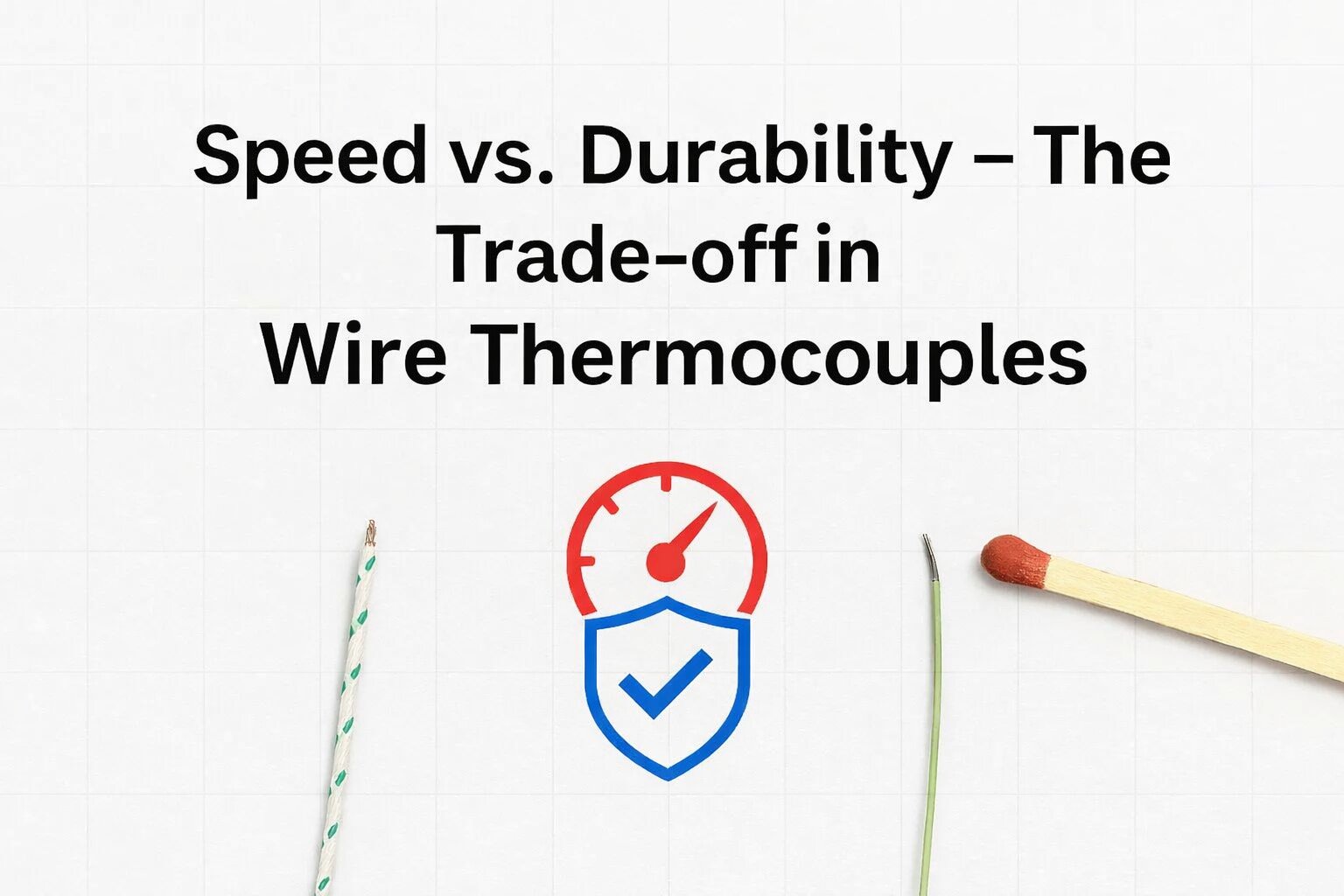
When selecting and designing wire thermocouples, users often face a classic conflict of objectives: measurement speed versus service life.
The basic principle
The smaller the mass of the measuring point, the faster the thermocouple reacts.
Thin wires and compact measuring tips have a low heat capacity. This allows the thermocouple to adapt to temperature changes within a very short time and deliver dynamic measurement results. This is a decisive advantage in processes with rapid temperature changes or in safety-critical control systems.
However, the thinner the thermowires, the lower their resistance to high temperatures.
Oxidation increases significantly under continuous exposure to temperatures of several hundred degrees Celsius. Thin wires wear out faster, their service life decreases, and the risk of “glow” increases. The thermocouple also “ages” very quickly, so that the accuracy of the class is no longer guaranteed.
The difference in practice
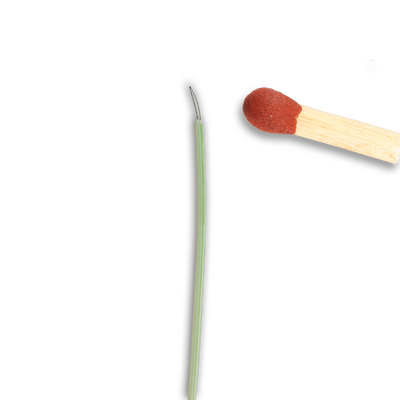
Type K, 2×0.08 mm (AWG40)
Teflon | Type K | 2x 0.08 mm AWG40 | +400°C
- Thermocouple pairing: Type K, Class 1
- Insulation: PFA Teflon, briefly up to 300°C
- Operating temperature: -100°C to +250°C
- Measuring point operating temperature: +400°C
- Advantage: Very fast response, ideal for dynamic measurements
- Disadvantage: Limited temperature resistance and shorter service life
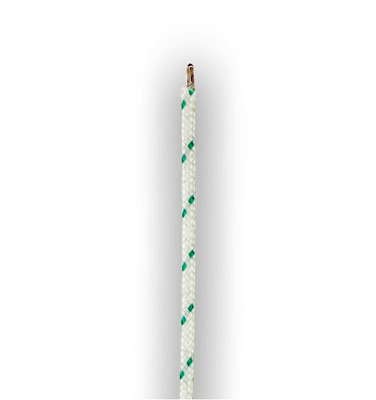
Type K, 2×0.5 mm (AWG24)
Glass fiber | Type K | 2x 0.5 mm AWG24 | 750 °C
- Thermocouple pairing: Type K, Class 1
- Insulation: Glass fiber, briefly up to 450°C
- Operating temperature: -20°C to +350°C
- Measuring point operating temperature: +750°C
- Advantage: Robust, higher temperature resistance, longer service life
- Disadvantage: Slower response to temperature changes
Why is that?
Reaction speed: The reaction time depends directly on the wire diameter. Thin wires have less mass that needs to be heated and a more favorable surface-to-volume ratio. As a result, the 0.08 mm thermocouple reacts significantly faster than the 0.5 mm model.
Oxidation: At temperatures above approximately 400 °C, oxidation becomes increasingly critical. Thin wires have less material that can withstand the oxidation process and therefore fail much earlier at high temperatures than thicker wires.
Influence of the measuring medium: The reaction speed depends heavily on the medium. Thermocouples react much faster in liquids such as water than in gases, as heat transfer is much more efficient. The flow velocity of the medium also has a significant influence on the reaction time.
Overview of typical wire diameters
Ultra-thin wires (0.08–0.127 mm):
Extremely fast response, ideal for research, flow measurements, and dynamic processes. Service life at high temperatures: Hours to a few days.
Thin wires (0.20–0.25 mm):
Good compromise for industrial control and process monitoring. Service life at high temperatures: days to weeks.
Standard wires (0.50–0.80 mm):
Robust and durable for continuous operation and low-maintenance applications. Service life at high temperatures: weeks to months.
Making the right choice
Choose thin wires (< 0.20 mm) if:
- Fast response times are crucial
- Regular replacement is possible
- Temperatures are below 400 °C
- Easy access to the sensor is available
Choose thick wires or sheathed thermocouples (≥ 0.5 mm) if:
- Continuous operation is required
- High temperatures (> 600 °C) are present
- Low-maintenance operation is important
- Mechanical stress is to be expected
Possible solutions
Planned replacement: Thin wires with deliberate, regular replacement for optimum measurement speed.
Robust permanent solution: Thick wires or sheathed thermocouples for long service life.
Hybrid solution: Two thermocouples in parallel – one fast for control, one robust as a reference.
Conclusion
For fast measurements in dynamic processes (e.g., in flow and combustion technology), thin wires with a very small measuring point are preferred – often in the range of 0.20 mm or smaller.
For continuous operation at high temperatures, however, a more robust design with a larger wire diameter and protected measuring tip is recommended. In other words, sheathed thermocouples.
The trick is to adapt the thermocouple to the specific application: speed and accuracy where they are needed—stability and service life where they are crucial.
There is no universal solution. The right choice depends on the specific application.