


Pt100 / Pt1000 wiring in 2, 3 and 4 wire circuits
Configuring your Pt100 wiring to match the measuring chain
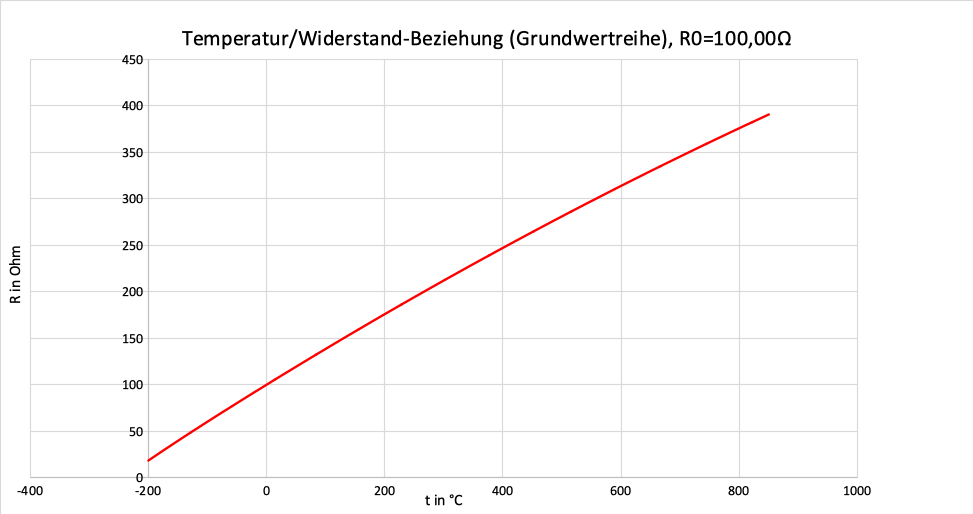
Whether a reading still holds true at the end of the cable depends on the sensor and, just as much, on the Pt100 wiring. The platinum element delivers exactly 100 Ω at 0 °C, and every kelvin adds around 0.385 Ω. Each conductor between probe and evaluation unit carries a resistance of its own, and that resistance is superimposed on this small signal.
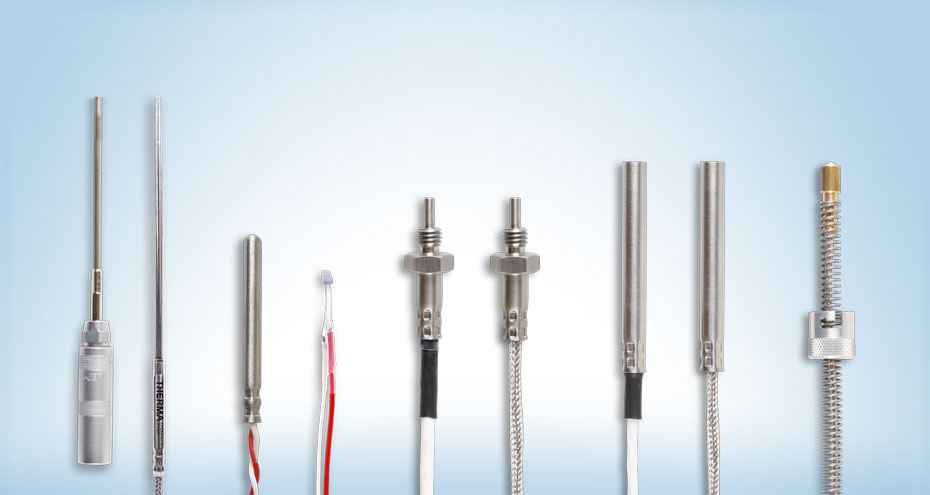
Measurement technology therefore distinguishes three connection types. Over short distances between probe and evaluation unit, a Pt100 2 wire circuit is enough. Everything beyond that is handled by Pt100 3 wire and four-wire designs. Which Pt100 wiring suits you depends on cable length, on the accuracy you require and on the input of your transmitter. Our range of resistance thermometers covers all three versions, from the cryogenic range at -200 °C through to process engineering.
Therma has manufactured in Lindlar since 1991, 100% by hand and to ISO 9001. You specify the number of conductors, the cable material and the length, and we build the Pt100 connection accordingly. Standard probes usually leave our works within one week, while custom designs to drawing or STEP file take one to two weeks.
How 3 wire Pt100 RTD wiring compensates for lead resistance
How large does the error become in the simplest version? With a Pt100 2 wire circuit, the full resistance of the outgoing and return conductor adds to the sensor value, and 1 Ω of lead resistance shifts the reading by roughly 2.6 K. Even a 10 m copper strand with 0.22 mm² reaches that value without anything being wrong at the probe.
This is precisely where 3 wire Pt100 RTD wiring comes in. One extra conductor runs from the sensor terminal back to the instrument and makes the lead resistance visible to the electronics. Provided all three conductors share the same cross-section and the same length, the instrument subtracts that share arithmetically, and most of the lead error disappears with it.
For the majority of industrial measuring points this Pt100 wiring is sufficient. Plant engineering, heating and refrigeration technology or process monitoring mostly work with it, because effort and accuracy stay in a sensible balance here. How strongly a deviation shows up at a given temperature becomes visible in our Pt100 resistance calculator.

Temperature/resistance relationship table PT 100 & 1000
| t [°C] | R0=100 [Ω] | R0=1000 [Ω] |
| -200 | 18,5 | 185,2 |
| -150 | 39,7 | 397,2 |
| -100 | 60,3 | 602,6 |
| -50 | 80,3 | 803,1 |
| 0 | 100,0 | 1000,0 |
| 100 | 138,5 | 1385,1 |
| 200 | 175,9 | 1758,6 |
| 300 | 212,1 | 2120,5 |
| 400 | 247,1 | 2470,9 |
| 500 | 281,0 | 2809,8 |
| 600 | 313,7 | 3137,1 |
| 700 | 345,3 | 3452,8 |
| 800 | 375,7 | 3757,0 |
| 850 | 390,5 | 3904,8 |
| t [°C] | R0=100 [Ω] | R0=1000 [Ω] |
| -200 | 18,5 | 185,2 |
| -190 | 22,8 | 228,3 |
| -180 | 27,1 | 271,0 |
| -170 | 31,3 | 313,4 |
| -160 | 35,5 | 355,4 |
| -150 | 39,7 | 397,2 |
| -140 | 43,9 | 438,8 |
| -130 | 48,0 | 480,0 |
| -120 | 52,1 | 521,1 |
| -110 | 56,2 | 561,9 |
| -100 | 60,3 | 602,6 |
| -90 | 64,3 | 643,0 |
| -80 | 68,3 | 683,3 |
| -70 | 72,3 | 723,3 |
| -60 | 76,3 | 763,3 |
| -50 | 80,3 | 803,1 |
| -40 | 84,3 | 842,7 |
| -30 | 88,2 | 882,2 |
| -20 | 92,2 | 921,6 |
| -10 | 96,1 | 960,9 |
| 0 | 100,0 | 1000,0 |
| 10 | 103,9 | 1039,0 |
| 20 | 107,8 | 1077,9 |
| 30 | 111,7 | 1116,7 |
| 40 | 115,5 | 1155,4 |
| 50 | 119,4 | 1194,0 |
| 60 | 123,2 | 1232,4 |
| 70 | 127,1 | 1270,8 |
| 80 | 130,9 | 1309,0 |
| 90 | 134,7 | 1347,1 |
| 100 | 138,5 | 1385,1 |
| 110 | 142,3 | 1422,9 |
| 120 | 146,1 | 1460,7 |
| 130 | 149,8 | 1498,3 |
| 140 | 153,6 | 1535,8 |
| 150 | 157,3 | 1573,3 |
| 160 | 161,1 | 1610,5 |
| 170 | 164,8 | 1647,7 |
| 180 | 168,5 | 1684,8 |
| 190 | 172,2 | 1721,7 |
| 200 | 175,9 | 1758,6 |
| 210 | 179,5 | 1795,3 |
| 220 | 183,2 | 1831,9 |
| 230 | 186,8 | 1868,4 |
| 240 | 190,5 | 1904,7 |
| 250 | 194,1 | 1941,0 |
| 260 | 197,7 | 1977,1 |
| 270 | 201,3 | 2013,1 |
| 280 | 204,9 | 2049,0 |
| 290 | 208,5 | 2084,8 |
| 300 | 212,1 | 2120,5 |
| 310 | 215,6 | 2156,1 |
| 320 | 219,2 | 2191,5 |
| 330 | 222,7 | 2226,8 |
| 340 | 226,2 | 2262,1 |
| 350 | 229,7 | 2297,2 |
| 360 | 233,2 | 2332,1 |
| 370 | 236,7 | 2367,0 |
| 380 | 240,2 | 2401,8 |
| 390 | 243,6 | 2436,4 |
| 400 | 247,1 | 2470,9 |
| 410 | 250,5 | 2505,3 |
| 420 | 254,0 | 2539,6 |
| 430 | 257,4 | 2573,8 |
| 440 | 260,8 | 2607,8 |
| 450 | 264,2 | 2641,8 |
| 460 | 267,6 | 2675,6 |
| 470 | 270,9 | 2709,3 |
| 480 | 274,3 | 2742,9 |
| 490 | 277,6 | 2776,4 |
| 500 | 281,0 | 2809,8 |
| 510 | 284,3 | 2843,0 |
| 520 | 287,6 | 2876,2 |
| 530 | 290,9 | 2909,2 |
| 540 | 294,2 | 2942,1 |
| 550 | 297,5 | 2974,9 |
| 560 | 300,8 | 3007,5 |
| 570 | 304,0 | 3040,1 |
| 580 | 307,3 | 3072,5 |
| 590 | 310,5 | 3104,9 |
| 600 | 313,7 | 3137,1 |
| 610 | 316,9 | 3169,2 |
| 620 | 320,1 | 3201,2 |
| 630 | 323,3 | 3233,0 |
| 640 | 326,5 | 3264,8 |
| 650 | 329,6 | 3296,4 |
| 660 | 332,8 | 3327,9 |
| 670 | 335,9 | 3359,3 |
| 680 | 339,1 | 3390,6 |
| 690 | 342,2 | 3421,8 |
| 700 | 345,3 | 3452,8 |
| 710 | 348,4 | 3483,8 |
| 720 | 351,5 | 3514,6 |
| 730 | 354,5 | 3545,3 |
| 740 | 357,6 | 3575,9 |
| 750 | 360,6 | 3606,4 |
| 760 | 363,7 | 3636,7 |
| 770 | 366,7 | 3667,0 |
| 780 | 369,7 | 3697,1 |
| 790 | 372,7 | 3727,1 |
| 800 | 375,7 | 3757,0 |
| 810 | 378,7 | 3786,8 |
| 820 | 381,7 | 3816,5 |
| 830 | 384,6 | 3846,0 |
| 840 | 387,6 | 3875,5 |
| 850 | 390,5 | 3904,8 |

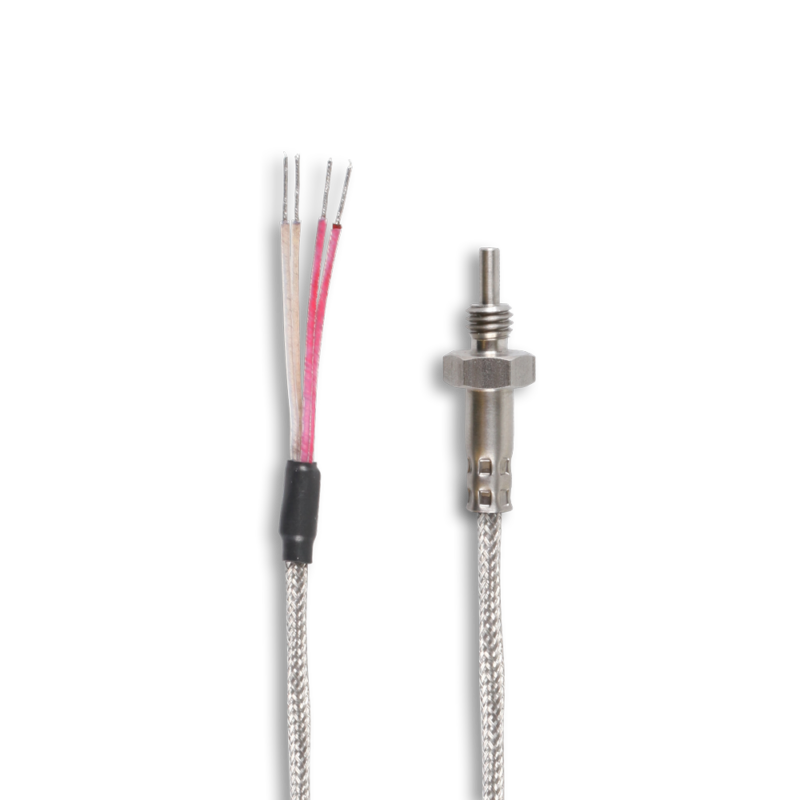
Cable lug RTD | Teflon | Pt100
21,86 € 
Sheathing | without wire | Pt100
59,40 € Sheathing | Fibreglass | Pt100
67,25 € Sheathing tube | Teflon | Pt100
21,10 € 
Other resistance thermometers
Pt100 4 wire connection for laboratory-grade accuracy
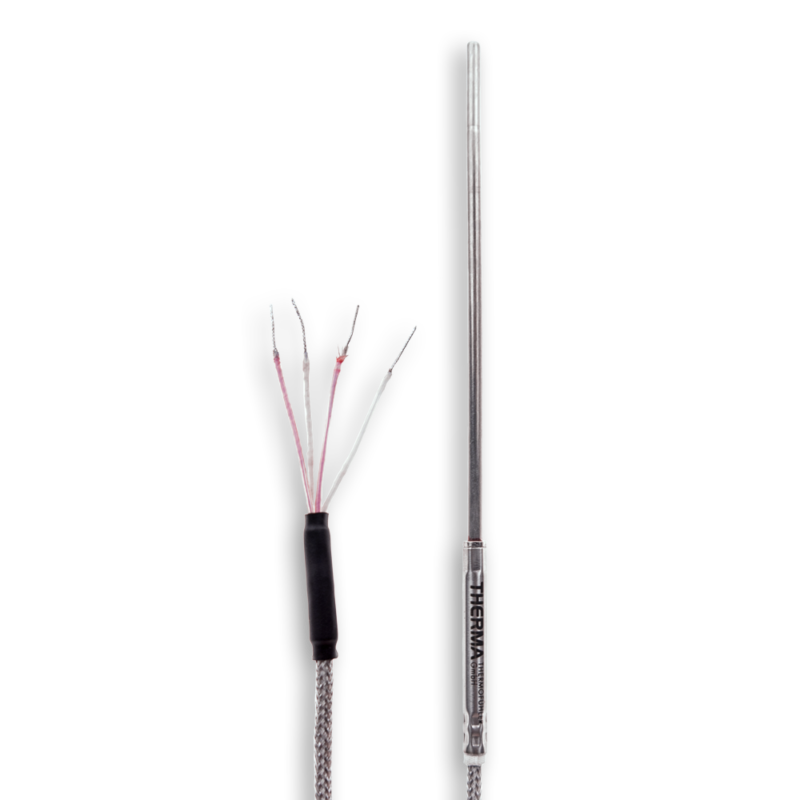
The Pt100 4 wire connection separates current injection and voltage measurement completely. Two conductors feed in the measuring current, the other two pick up the voltage directly at the platinum element. Because virtually no current flows through the measuring conductors, no voltage drops across them, so the lead resistance vanishes from the result entirely.
Calibration laboratories, test benches and reference measurements consistently rely on this four-wire design. In metrology, that Pt100 wiring counts as the reference against which the other two are judged. Cable runs beyond 30 m or class AA to DIN EN 60751 justify the extra effort as well, because an asymmetric installation would corrupt the three-wire compensation. You pay with additional terminals and conductor cross-section and receive the most reliable measurement in return. Our factory calibration covers -30 to +650 °C, and above that we work with DAkkS calibration to DIN EN ISO/IEC 17025.
Which wiring configuration suits your application?
Compare the measuring task and the cabling before you order, because the transmitter input has to support the configuration you choose. Which terminals are assigned is shown in the Pt100 wiring diagram of the data sheet. In particular, the Pt100 3 wire connection diagram deserves a second look. Anyone comparing a Pt100 RTD wiring diagram across manufacturers will find the same three basic circuits. Choose wrongly and you pay for it either in accuracy or in unnecessary material. The overview below sorts the three versions by accuracy and typical use.
| Circuit | Conductors | Lead error | Typical length | Application |
|---|---|---|---|---|
| 2-wire | 2 | applies in full, approx. 2.6 K per Ω | up to 3 m | Control cabinet, series components |
| 3-wire | 3 | largely compensated | up to 30 m | Plant engineering, process technology |
| 4-wire | 4 | completely eliminated | over 30 m | Laboratory, calibration, test bench |
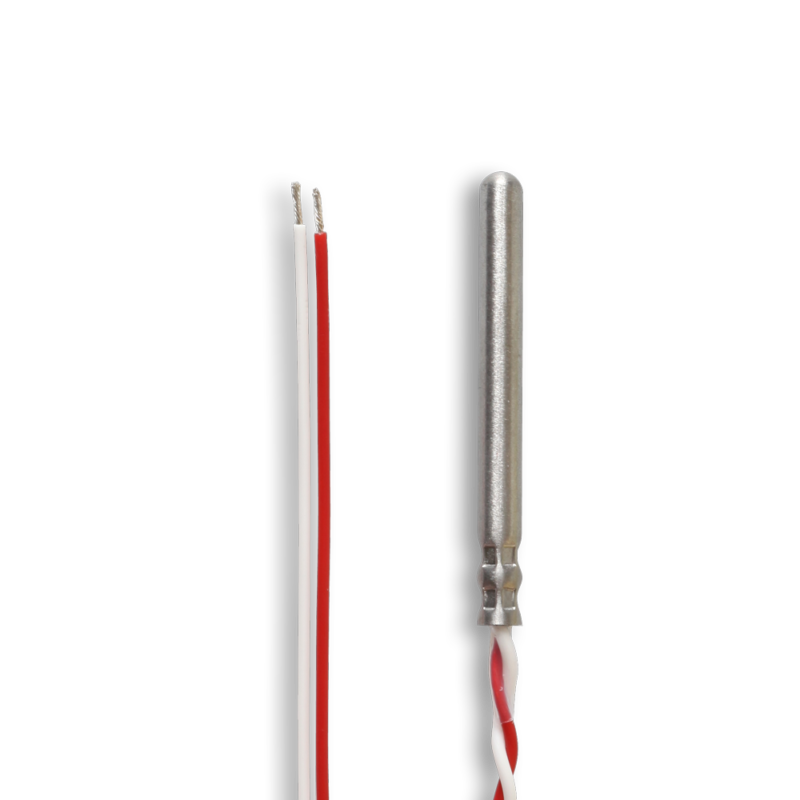
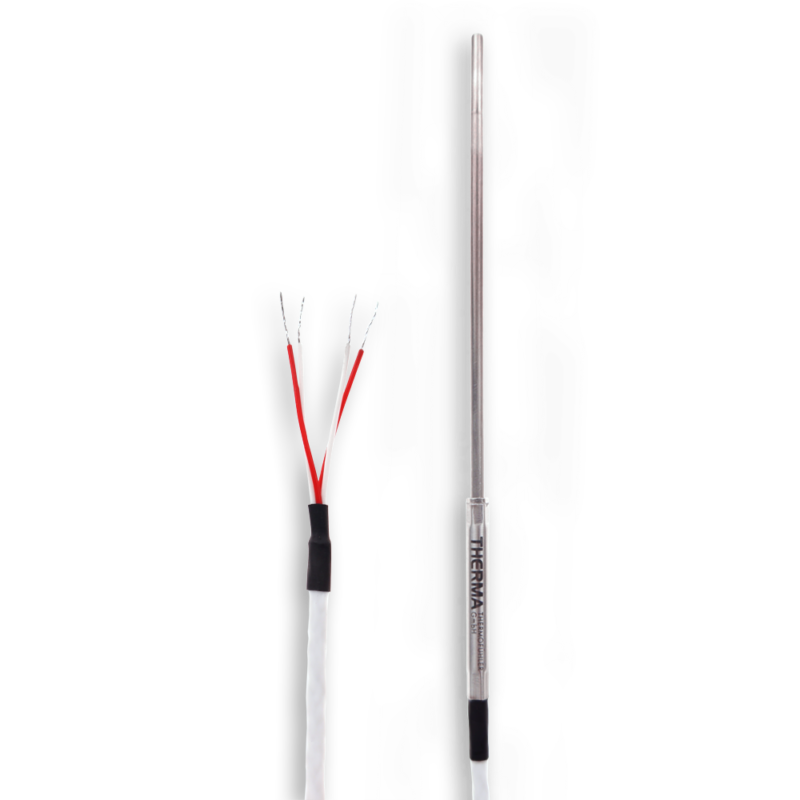
Industry has settled on the Pt100 3 wire connection as the working compromise, while two-wire technology remains sensible only over very short distances. Both stay valid options as long as you plan the Pt100 wiring together with the cable route. Colour coding follows DIN EN 60751, with two red conductors on one side of the sensor and one white conductor on the other; the Pt100 connection diagram of the respective series shows the details. We supply matching Pt100 temperature sensors pre-assembled with the number of conductors you select.
Pt1000 wiring as an alternative with a high base resistance
The Pt1000 starts at 1000 Ω at 0 °C and changes by 3.85 Ω per kelvin. The same lead resistance of 1 Ω causes only around 0.26 K of deviation here, a tenth of the Pt100 error. Where a Pt100 would long since need a third conductor, Pt1000 wiring often remains usable with two.
As soon as reference accuracy or very long cable runs come into play, four conductors pay off with the Pt1000 as well. Battery-powered data loggers benefit from the smaller measuring current, and self-heating of the element drops. Check before selecting whether your instrument processes the characteristic curve at all, because not every input accepts both sensor types. Our Pt1000 temperature sensors come in the same designs as the Pt100 versions.
Are you unsure which Pt100 wiring suits your transmitter? Our team in Lindlar reviews your application and recommends the number of conductors, the tolerance class and the cable material. Companies, trade businesses and institutions receive volume-based pricing on request, and shipping within Germany is free of charge from an order value of 250 EUR.
